WholeTech Picks|WholeTechTVReviewer.comTexas Coworking
The standardized exam for the agent era

How well do you actually work with coding agents?

By WholeTech · updated

PACE — the Practical Agentic Coding Exam. 800 points, four disciplines, one score that says how good you really are at building with coding agents.

PACE Score ReportID 7F3A-2026
740/ 800
Frontier tier
Direction180/200
Verification195/200
Context175/200
Leverage190/200
The problem

Everyone codes with AI now. Nobody can measure who's good at it.

A resume says where you went to school. A LeetCode score measures coding without AI — a skill that's fading. Neither tells you the thing that now matters most: can you get frontier work out of an agent? Right now that's a hunch. PACE turns it into a number.

45×
more code shipped by the top 1% of AI engineers than the median — the gap PACE measures (Cursor, 2025).
−20%
how much slower developers actually were when they *felt* 20% faster with AI. Self-assessment is broken (METR, 2025).
800
points, SAT-style — 200 to 800, four sections of 200. One score you can put on a resume.
420
vetted questions in the bank — every sitting draws a fresh randomized 40, so no two exams are alike.
The exam

Four disciplines. 200 points each.

Not trivia about flags and syntax — the exam scores how you actually drive an agent, drawn from how the best operators work.

Direction

200 PTS · PROMPTING & DECOMPOSITION

Framing a task so an agent can nail it: the right scope, the right constraints, when to plan vs. when to let it run. Can you brief a worker who's brilliant but literal?

Verification

200 PTS · TRUST BUT CHECK

The single biggest separator. After the agent changes six files, how do you know it did what you asked — and nothing you didn't? Deterministic checks, diff review, catching the confident-but-wrong.

Context

200 PTS · FEED IT RIGHT

The biggest driver of cost and quality. Giving enough to decide well, without bloating the window. When to compact, what belongs in memory, what poisons a session.

Leverage

200 PTS · VELOCITY

Parallel sessions, worktrees, skills, orchestration, overnight runs. Turning one operator into a team — the difference between using an agent and commanding several.

Sample question

See how it reads.

Section 2 · Verification

Your agent finishes a task and reports all tests pass. You have 30 seconds before a meeting. What's the highest-leverage move?

Answer: B. Verification isn't re-running what the agent already ran (D) or asking for more of the agent's own work (C). It's a fast human check that the change matches the request and didn't smuggle in unrequested edits — where agents most often go wrong. Trusting the green (A) is exactly the habit PACE penalizes.
Scoring

One number, four tiers.

200–490
Novice. You use AI, but it doesn't yet multiply you — you're still coding, just with autocomplete.
500–599
Proficient. A reliable single-agent operator. You ship real work and mostly catch the misses.
600–699
Advanced. Verification, context discipline, and parallelism are habits, not afterthoughts.
700–800
Frontier. The 45× tier. You architect work for agents and run several at once. This is who teams are hunting for.
Tool-neutral by design

PACE measures the operator, not the vendor. The skills transfer across every serious coding agent.

Claude CodeCodexCursorCopilotGemini CLI…and whatever ships next
Questions

PACE, briefly

What is PACE?

PACE is the Practical Agentic Coding Exam — a standardized test of how well you work with coding agents like Claude Code, Codex, and Cursor. It scores four disciplines (Direction, Verification, Context, Leverage) on a 200–800 SAT-style scale.

How is PACE scored?

Each sitting draws a random 40 questions from a 420-question bank — 10 per discipline. Every discipline is worth 200 points; scores are computed server-side and total 200–800. Tiers: Novice, Proficient, Advanced, and Frontier (700+).

Can the exam be cheated or rigged?

It is built not to be: answers never leave the server, every sitting gets a different randomized draw with shuffled options, the clock is enforced server-side, each sitting can be submitted exactly once, and retakes are limited to one per person every 30 days.

Are PACE certificates verifiable?

Yes. Every certificate is cryptographically signed and has a public verification page — anyone can confirm a score at pace.wholetech.com/verify/ plus the certificate ID. Forged IDs simply return not-found.
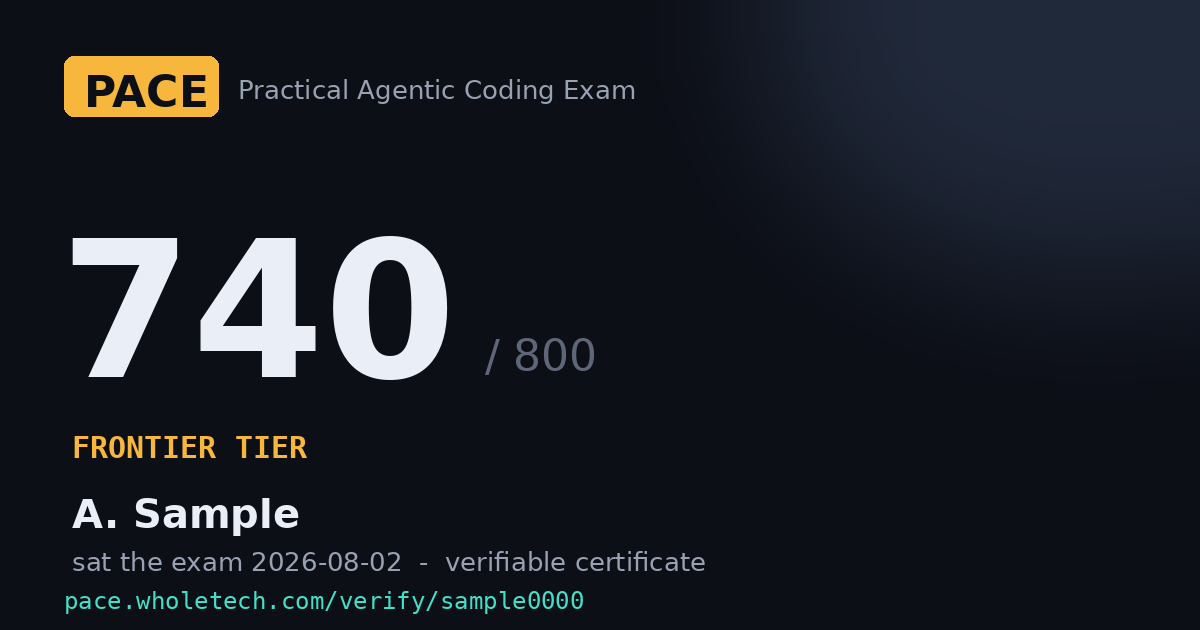
A sample PACE share card: score 740 of 800, Frontier tier, with a public verification URL

Is PACE proctored?

The beta is unproctored and free. A proctored tier is planned. Your newest certificate always supersedes older ones.

Which AI coding tools does PACE cover?

The exam is deliberately tool-neutral: it tests operator judgment that transfers across Claude Code, Codex, Cursor, Copilot, Gemini CLI, and whatever ships next — not any single vendor’s menus.

Early access

Get your number first.

PACE is in development. Join the waitlist to sit the first cohort, help calibrate the question bank, and put an early score on your profile.

No spam. One note when the first cohort opens.